
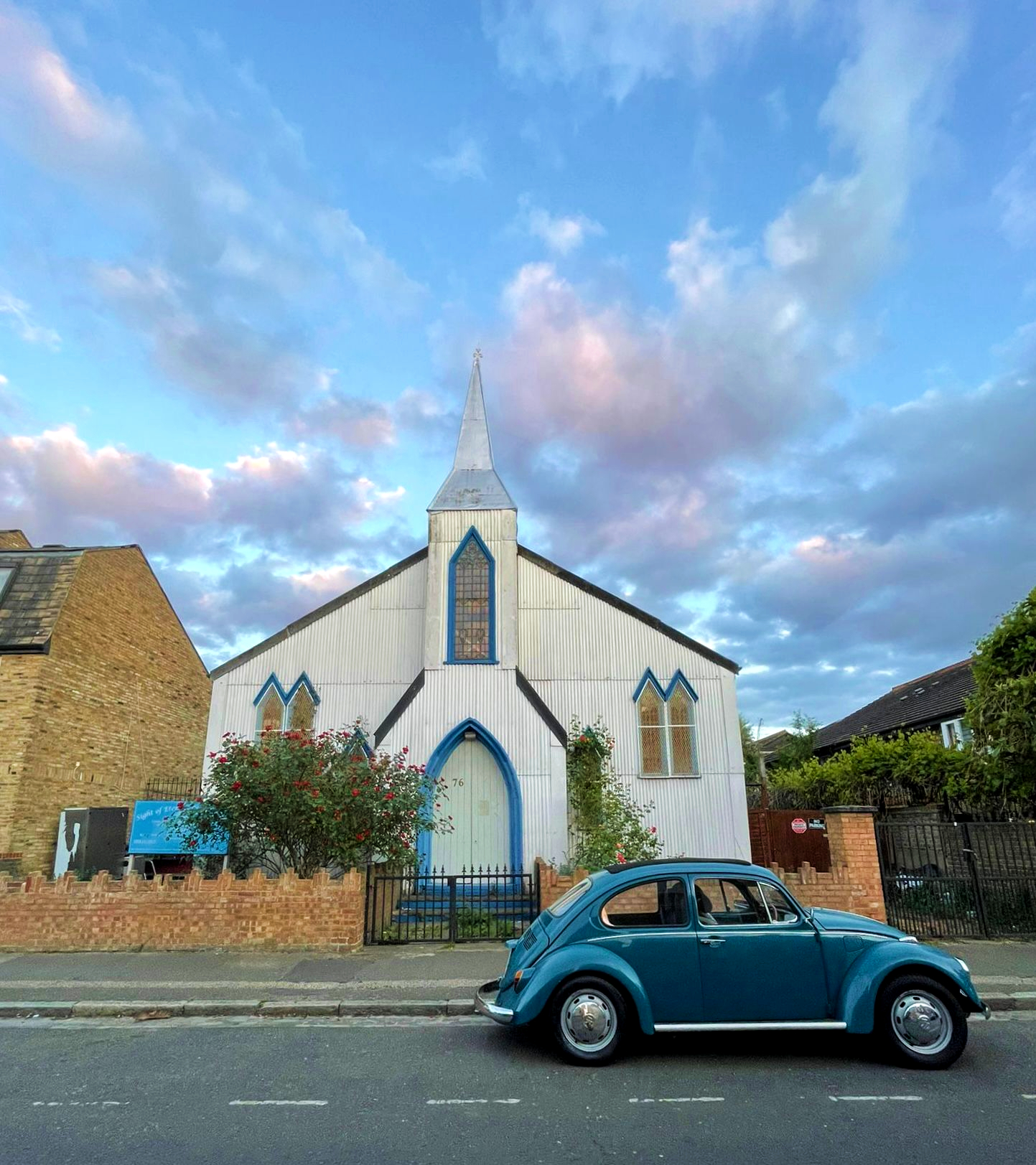
Nestled in Shrubland Road between Haggerston and Dalston stands one of Hackney’s most unusual and historically important religious buildings: the Shrubland Road ‘Tin Tabernacle’ (or perhaps it should be called the ‘Asbestos Tabernacle’), also known over the years as the Shrubland Road Evangelical Church and later the Sight of Eternal Life Church.
At first glance it appears modest and almost improvised, but this corrugated iron chapel is in fact regarded by many architectural historians as the oldest surviving iron church in Britain – and possibly the world. Built in 1858 as a temporary structure, it somehow survived while thousands of similar Victorian ‘tin tabernacles’ disappeared, making it one of the borough’s rarest surviving 19th-century buildings.
A Victorian Experiment in Corrugated Iron
The chapel was erected in 1858 for a Presbyterian congregation during a period of enormous population growth in East London. Haggerston and Dalston were expanding rapidly as working-class housing spread across former fields and market gardens, creating demand for cheap and quickly assembled places of worship.
Rather than constructing an expensive permanent church in brick or stone, the congregation chose one of the new prefabricated iron buildings that had begun appearing across Britain during the Industrial Revolution. Remarkably, the building was reportedly completed in only ten weeks at a cost of around £1,300 and could accommodate roughly 500 worshippers.
Although intended as a temporary chapel, it was surprisingly elaborate for an iron structure. The façade included Gothic-style pointed windows, a central entrance and a small bell-turret (or steeple) so that it resembled a miniature Victorian church despite being made from industrial materials.
Most iron churches were later demolished once permanent buildings were constructed, which makes the survival of the Shrubland Road chapel particularly extraordinary.
The Age of the ‘Tin Tabernacle’
The Shrubland Road chapel belongs to a fascinating but often overlooked chapter of Victorian architecture. So-called ‘tin tabernacles’ were prefabricated churches manufactured in kit form and shipped around Britain and across the British Empire during the 19th century.
Corrugated iron had only recently become commercially practical and manufacturers promoted these buildings as fast, affordable and portable solutions for rapidly growing communities. Thousands were erected between the 1850s and the early 20th century.
Many Victorians disliked them. The designer and social critic William Morris famously condemned corrugated iron buildings as spreading “like a pestilence” across the countryside. Yet despite criticism from architectural traditionalists, they became especially important in poorer districts where conventional church construction was financially impossible.
One lesser-known detail about the Shrubland Road Tabernacle is that it appeared unusually early in the history of corrugated iron churches. Most surviving iron churches date from the 1880s or later, whereas the Hackney chapel pre-dates the great boom in tin tabernacle construction by several decades.
Congregations and Changing Faiths
Although originally Presbyterian, the chapel later became associated with Congregationalist worship during the 19th century, reflecting the fluid religious landscape of Victorian Hackney.
Nonconformist congregations were particularly strong in the East End, where independent chapels often played a major social role alongside their religious functions. For many local residents these buildings were centres for education, charity work, temperance meetings and social gatherings as much as places of worship.
In 1971 the building entered another phase of its life when it became home to the Sight of Eternal Life Church, an evangelical congregation which occupied it for decades afterwards. By then the chapel had become a familiar local landmark, standing out amid post-war estates and industrial buildings.
Older residents sometimes referred to it simply as ‘The Shrub’. Despite changes in congregation and neighbourhood demographics, the building remained in continuous religious use for well over a century, something relatively uncommon among surviving tin tabernacles.
Interior Survival and Rare Features
One reason the building is considered so important is the remarkable survival of its interior. Historic England’s listing describes original iron roof trusses with “decorative Gothic spandrels, timber rafters, wooden pews and an intact raised reading platform with twisted balusters and a curved pulpit”. An organ also survives at the eastern end of the chapel.
While the exterior appears weathered and utilitarian, the interior still preserves much of the atmosphere of a Victorian mission church. The survival of these features is particularly rare because iron churches were usually treated as expendable. Many were dismantled, relocated or heavily altered. Some were even converted into village halls, scout huts or industrial workshops.
The Shrubland Road chapel escaped such drastic rebuilding, meaning historians can still study an almost complete example of an early prefabricated iron church. Its Grade II listing, granted in 1997, recognised both its architectural rarity and its importance in the history of industrial building methods.
The Asbestos Paradox
One of the most unusual aspects of the building is the material now covering much of its exterior. Although celebrated as a ‘tin tabernacle’, many of the original corrugated iron panels were replaced during the 20th century with corrugated asbestos cement sheeting. Historic England specifically notes that the chapel is no longer clad primarily in its original iron skin.
This creates a major conservation dilemma. Asbestos cement was once considered a durable and economical replacement material, but it is now heavily regulated because of the health risks associated with asbestos fibres. Removing it safely is expensive and technically difficult, especially on a Grade II listed structure where preserving historic fabric is legally important.
The result is a paradoxical situation: one of Britain’s most famous surviving ‘tin churches’ is now partly covered in asbestos. Conservation specialists have noted that this complication is one of the reasons restoration and redevelopment efforts have repeatedly stalled.
Heritage at Risk and an Uncertain Future
Today the chapel remains on Historic England’s Heritage at Risk Register, where its condition is described as fair but declining, with high vulnerability. Despite its architectural importance, finding a viable long-term use for the building has proven difficult.
Strict listed-building protections, restoration costs and asbestos complications have discouraged potential buyers and developers. In recent years the property has reportedly been marketed for sums approaching £1.7 million or more, but no permanent solution has emerged.
Yet the building continues to fascinate historians, photographers and local residents. Hidden among ordinary East London streets, the Shrubland Road ‘Tin Tabernacle’ is a rare survivor from the earliest age of prefabricated architecture and Victorian missionary expansion.
What was supposed to last only temporarily has endured for more than 165 years, outliving countless grander churches and becoming one of Hackney’s most distinctive and fragile historic landmarks.
Hackney’s Unexpected Connection to Corrugated Iron
There is an intriguing local connection to the Shrubland Road Tin Tabernacle that often goes unnoticed. The man credited with inventing corrugated iron, Henry Robinson Palmer, was born in Hackney in 1795.
A pioneering civil engineer and one of the founders of the Institution of Civil Engineers, Palmer patented corrugated iron in 1829 while working for the London Dock Company. His invention transformed what had previously been relatively weak sheet iron into a lightweight yet remarkably strong building material by pressing it into parallel ridges and grooves.
Initially developed for industrial roofing, corrugated iron quickly became one of the 19th century’s most revolutionary construction materials. It made possible the rapid manufacture of portable schools, hospitals, railway buildings, military structures and the thousands of prefabricated churches that later became known as ‘tin tabernacles’.
Although Palmer died in 1844, fourteen years before the Shrubland Road chapel was built, his invention made buildings like it economically viable. In a fitting coincidence, one of Britain’s oldest surviving iron churches now stands only a short distance from the birthplace of the engineer whose invention helped make such buildings possible.
Leave a Reply