
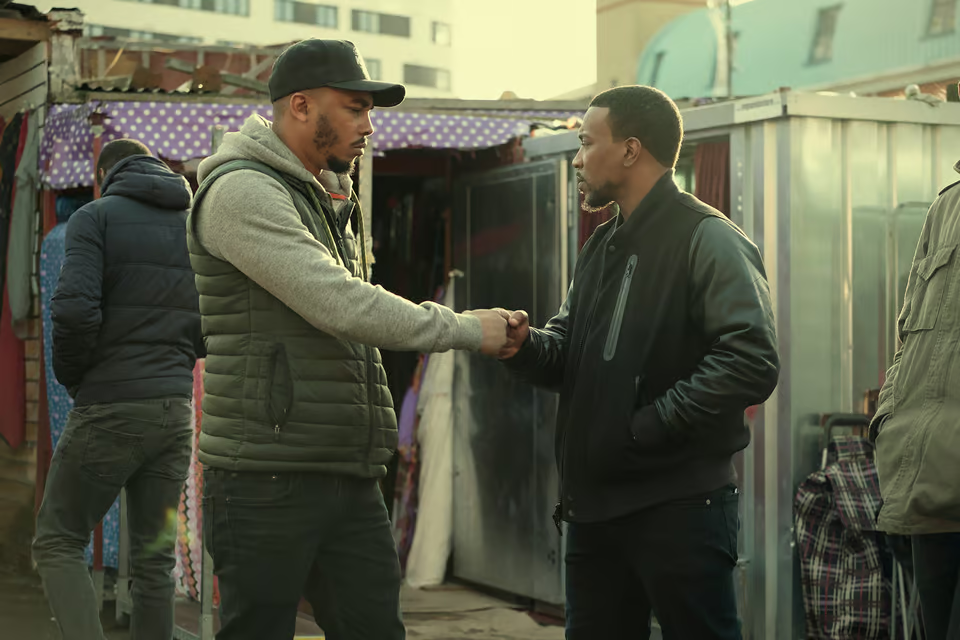
Top Boy is a Hackney story at heart, even though its fictional Summerhouse Estate has been assembled from real estates and streets across London. Behind the drugs, violence and rivalries, the series became an unusually sharp portrait of East London, its communities, inequalities, changing streets and the pressures created when an old neighbourhood becomes desirable to a new generation.
Born in Hackney
Top Boy was created and written by Ronan Bennett, who had lived in Hackney for many years when he developed the series. The idea grew partly from what he witnessed around him: Bennett has recalled seeing a young boy selling drugs outside a Tesco and becoming interested in the wider world behind such encounters.
Rather than making a conventional gangster drama, he wanted to explore the people living within that world and the social circumstances surrounding them. The first two series were broadcast by Channel 4 in 2011 and 2013, following Dushane Hill and Gerard ‘Sully’ Sullivan as they navigate the drugs economy, family relationships, poverty, loyalty and betrayal.
The series was cancelled after its second run, leaving its story unfinished. When Netflix eventually revived it, the original two series were rebranded ‘Top Boy: Summerhouse’ while the new episodes continued the story several years later.
Drake Brings Top Boy Back to Life
The unlikely second chapter of Top Boy owes a considerable debt to Drake. The Toronto-born rapper became a passionate fan of the original Channel 4 series after discovering it online and was reportedly surprised to learn that it had been cancelled.
Drake subsequently contacted Ashley Walters, who plays Dushane, and became determined to help bring the programme back. He and his business partner Adel ‘Future’ Nur eventually became executive producers, alongside Maverick Carter and Jamal Henderson.
In 2017 Netflix announced that it had commissioned a new chapter of Top Boy following Drake’s approach to the company. The revival reunited creator Ronan Bennett with the original production team and brought back Walters and Kane Robinson, better known as Kano, as Dushane and Sully.
Drake’s involvement nearly went further. There was discussion about finding him a role in the series, but he ultimately remained behind the camera. His appearance at an early cast read-through nevertheless made an impression on the actors and his involvement helped turn what had been a cancelled British cult drama into an internationally distributed Netflix series.

There is something particularly striking about that transformation. A global Canadian superstar helped resurrect a drama whose appeal depended on its very specific portrayal of London. Drake did not remake Top Boy into an American-style crime series: the original writers, actors and creative team remained central, allowing the show’s East London identity to survive its transition to a global streaming platform.
Summerhouse Isn’t a Real Estate
The Summerhouse Estate does not actually exist, while Hackney supplies much of the story’s cultural identity and wider geographical setting. One of the persistent misconceptions surrounding Top Boy is that the fictional estate corresponds neatly to one real housing estate, when in reality the production used different locations to create its distinctive setting.
The Heygate Estate in Elephant and Castle is frequently identified with the first series, but Andrew Pavord of FilmFixer, who was directly involved in location work on the production, has explained that the estate used extensively for Series 1 was deliberately left unnamed at residents’ request. He says that only the church on the Heygate Estate was used, while much of the estate itself was too dilapidated for filming.
By Series 2, with redevelopment and demolition underway, the production moved elsewhere, including the South Acton Estate in Ealing. This is an important distinction because Top Boy has always mixed fictional geography with real London locations.
De Beauvoir and the Summerhouse Look
Hackney’s De Beauvoir Estate subsequently became one of the locations associated with Summerhouse and helped establish the visual language of the Netflix-era series. Its concrete walkways, balconies, staircases and courtyards provided the dense modernist landscape required for the fictional estate.
The architecture is significant because Top Boy does not treat the estate as a generic backdrop. Communal spaces repeatedly become places where deals are made, relationships tested and rivalries played out. The physical design of post-war housing becomes part of the drama, creating spaces where private life and street life constantly overlap.
Samuda Estate: Summerhouse by the Thames
For the Netflix revival the Samuda Estate on Manchester Road in Cubitt Town (Isle of Dogs) became the principal real-world stand-in for Summerhouse. Built in 1967, the estate’s concrete blocks and 25-storey Kelson House sit within sight of Canary Wharf, creating one of the show’s most striking visual contrasts: a working-class residential community framed by some of London’s most valuable commercial real estate.
That juxtaposition was exactly what attracted the production. The Samuda Estate was built on land formerly occupied by the Samuda Brothers shipbuilding works and the estate itself forms part of the distinctive post-war housing landscape of Cubitt Town. Location manager Ben O’Farrell said the team loved Samuda because of the way the City and Canary Wharf could be seen from the estate, describing the contrast as something that said “something profound”.
There was also an unusually close relationship between the production and Samuda’s residents. When the Top Boy team arrived in 2017, they had initially hoped to find an empty estate, but eventually approached residents across Samuda for permission to film. Many agreed, and residents themselves appeared as extras. The production also filmed inside real flats, meaning that details such as residents’ mugs, kitchens and even full ashtrays became part of the finished series rather than being recreated as television props.
Dalston, Ridley Road and London Fields
Away from Summerhouse, Top Boy repeatedly returns to recognisable parts of East London. Ridley Road Market in Dalston appears as part of the characters’ everyday geography, while London Fields and surrounding neighbourhoods provide locations for meetings, encounters and the quieter moments between conflicts.
One of the programme’s strengths is that these places are not presented as isolated locations. Characters travel between estates, markets, cafés, parks and high streets in a way that reflects how people actually experience London. The geography creates connections between different communities and social worlds.
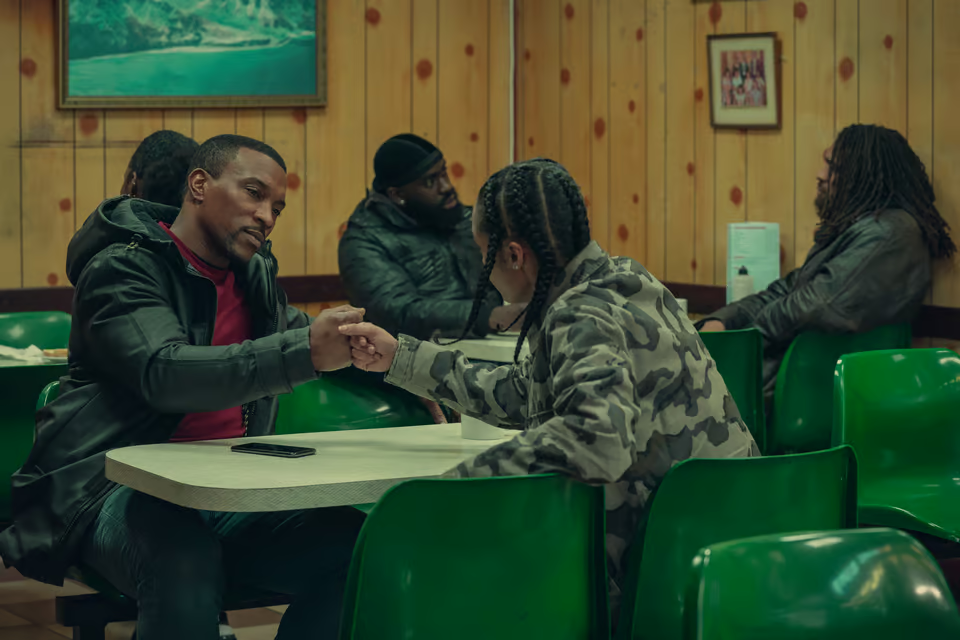
The use of real businesses adds another layer of authenticity. Number One Café on Well Street, for example, was used as a meeting place in the series. Rather than constructing an anonymous television café, the production incorporated an existing local business into the story, making the fictional world feel embedded in the real city.
A Story About a Changing Hackney
Gentrification is not simply scenery in Top Boy. It becomes part of the story. As Dushane and the other characters return to an East London that has changed around them, familiar streets contain new cafés, businesses and wealthier residents, while long-established communities continue to deal with insecure housing, unemployment and limited opportunities.
The contrast becomes particularly sharp when characters encounter places that have been transformed since they were younger. The arrival of expensive food and retail businesses can seem almost absurd when placed alongside the economic circumstances of the people who have lived in the area for years.
The show does not suggest that gentrification alone explains the violence of its characters, but it recognises the tension created when the value of land rises dramatically while many existing residents remain economically marginalised. The streets become contested in another sense: not only over territory between rival dealers, but over who can afford to remain in the neighbourhood at all.
More Than a Gangster Drama
The drugs trade provides the central engine of Top Boy, but the series is ultimately interested in people rather than simply criminal enterprises. Mothers try to protect their children, young people look for ways out, friendships compete with self-interest and family responsibilities collide with the demands of the street.
This is particularly important in the treatment of the younger characters. The series repeatedly shows how limited opportunities, unstable families and the search for status can intersect with the drugs economy. Criminality is neither romanticised nor presented as something completely detached from the social environment.
Just as importantly, the estates are not portrayed as places populated solely by criminals. There are friendships, romances, ordinary families, humour and community life alongside the violence. That balance prevents Summerhouse from becoming the kind of stereotypical ‘dangerous estate’ that appears in less nuanced depictions of London.
The Sound of East London
Music is fundamental to Top Boy’s sense of place. The series emerged from the same East London cultural environment that produced grime, British rap and later drill. Kano, who plays Sully, was already an important figure in British grime before joining the cast, while the soundtrack brings together music that reflects the changing sound of London across the show’s different eras.
That connection between music and place extends beyond the cast. Hackney has produced or nurtured numerous influential musicians and more recently became one of the prominent voices of the later UK drill generation. These musical worlds belong to the same broader London culture that Top Boy has documented.
Language works in much the same way. The dialogue draws heavily on the multicultural London English heard across contemporary East London, rather than forcing characters into standardised television speech. Slang, accents, rhythms and code-switching are integral to the characters’ identities and help locate the story socially as well as geographically.
Hackney as a Character
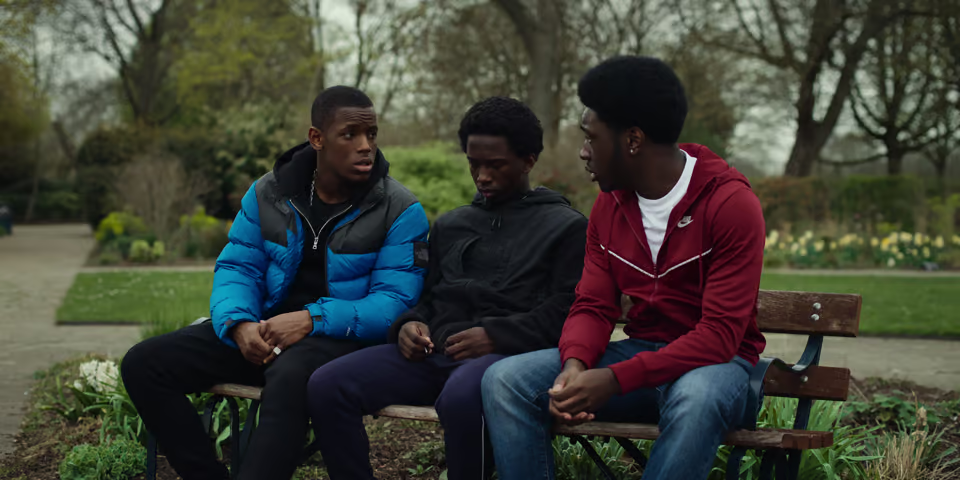
Perhaps the greatest achievement of Top Boy is that Hackney and the wider East London landscape are never merely a backdrop. Estates, markets, cafés, parks and changing high streets influence what the characters can do, where they belong and what they stand to lose. The series captures a period when council estates and long-established communities were increasingly existing alongside soaring property values, new businesses and rapid redevelopment.
This makes Top Boy valuable as something beyond a crime drama. It is also a record of a particular London at a particular moment: a city of extraordinary cultural energy and opportunity, but also one in which the people who grew up in its neighbourhoods could increasingly find themselves unable to afford the place they helped create.
Leave a Reply