
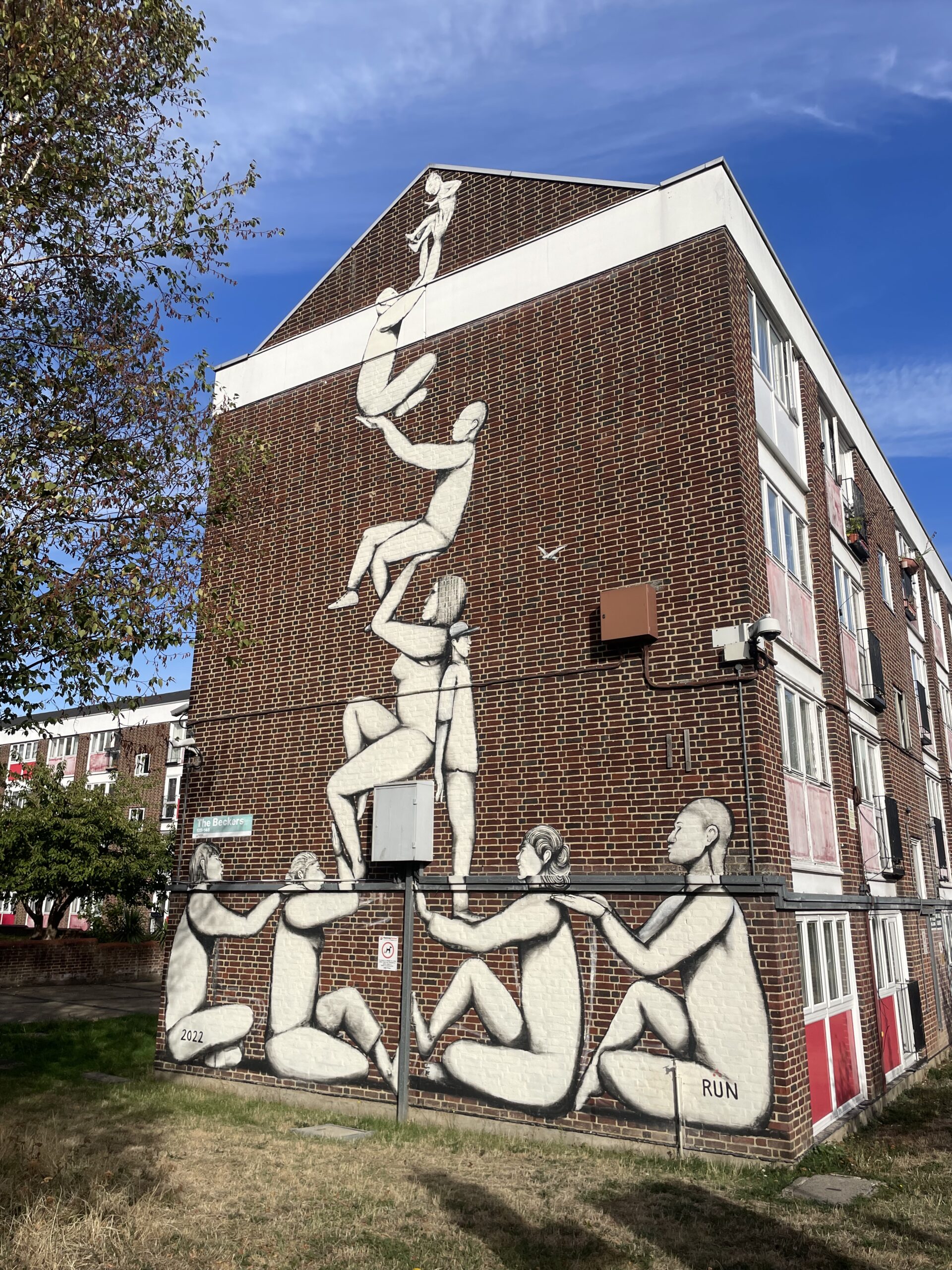
This piece of street art was created in 2022 by Italian artist RUN to celebrate the concepts of community, cooperation and mutual support. The mural covers the brick end wall of a residential block on The Beckers estate and it depicts a group of seated figures supporting a rising chain of human bodies, culminating in a small standing figure near the roofline, with each person contributing to the stability of those above.
The work was developed with residents of The Beckers and became the subject of a Hackney Council public consultation in January 2022. Its central theme was community, particularly the importance of helping friends, family and neighbours. The original proposal specified that the figures would be painted directly onto the exposed brickwork, without a background colour, using off-white, ochre and brown tones.
From Italian Graffiti to London’s Streets
Born in Ancona in 1979, RUN (Giacomo Bufarini) emerged from Italy’s underground graffiti scene before settling in East London, where he developed his distinctive style of intertwined human figures, exaggerated anatomy and symbolism inspired by ancient civilisations.
RUN began painting graffiti in Italy during the 1990s, experimenting with spray paint on trains, vehicles and abandoned buildings at a time when the country’s urban art movement was still developing. His early experiences brought him into contact with artists including BLU and Ericailcane, who helped establish a generation of Italian street art that moved beyond conventional graffiti lettering towards large-scale figurative painting.
Working increasingly with brushes, rollers and ordinary wall paint, Bufarini drew inspiration from classical Italian art, anatomical studies and prehistoric imagery. His compositions combine these influences with a fascination for the human form, often arranging bodies in unusual, almost impossible positions.
A Distinctive Presence in Hackney
In 2007 RUN moved to London, where East London’s industrial buildings, housing estates and brick façades offered a different environment for his work. Rather than treating walls simply as blank canvases, he adapted his paintings to their architecture, incorporating the proportions and irregularities of individual buildings into his designs.
Hackney became an important base for RUN, whose paintings started appearing across Clapton, Shoreditch and other parts of East London. He also established Bodega, a studio and creative space on Lower Clapton Road (now closed), which helped him maintain a direct connection with the neighbourhood.
In August 2018 he attracted attention for two self-funded murals in Clapton, including a painting on Downs Road depicting holidaymakers relaxing on a beach alongside migrants struggling to reach the shore. The work demonstrated his willingness to address uncomfortable social and political subjects through public art.
Speaking to the Hackney Citizen at the time, Bufarini criticised the increasing commercialisation of East London’s street art scene. As murals became tourist attractions and opportunities for corporate promotion, he questioned the influence of commercial interests on artists and the public spaces they occupied. Financing his own projects allowed him greater freedom to choose both his subjects and locations.
In 2020 RUN became an artist-in-residence at Grow in Hackney Wick, working from its environmentally designed Eco Pod. The residency began shortly before the first Covid lockdown, prompting him to reconsider his working methods. During this period, he developed drawings, paintings, prints and murals while exploring the effects of isolation and the disruption of everyday life.
From Shoreditch to International Recognition
By the 2010s RUN had established an international reputation, producing murals in countries including China, Senegal and Morocco.
A significant moment came in 2014 with ‘Parabola di G’ at the Howard Griffin Gallery on Shoreditch High Street. Rather than presenting a conventional exhibition of paintings, Bufarini created an immersive installation based on a semi-autobiographical illustrated narrative. Visitors entered a fictional setting populated by strange characters, symbolic landscapes and architectural structures. It was also the first exhibition in which he prominently presented himself under his real name rather than solely as RUN.
In 2021 he collaborated with the Fitzwilliam Museum in Cambridge on ‘The Human Touch’, an exhibition examining the significance of physical contact across thousands of years of art and history. His large-scale imagery of hands complemented works ranging from ancient sculpture to contemporary representations of intimacy, communication and touch.
People Lifting People
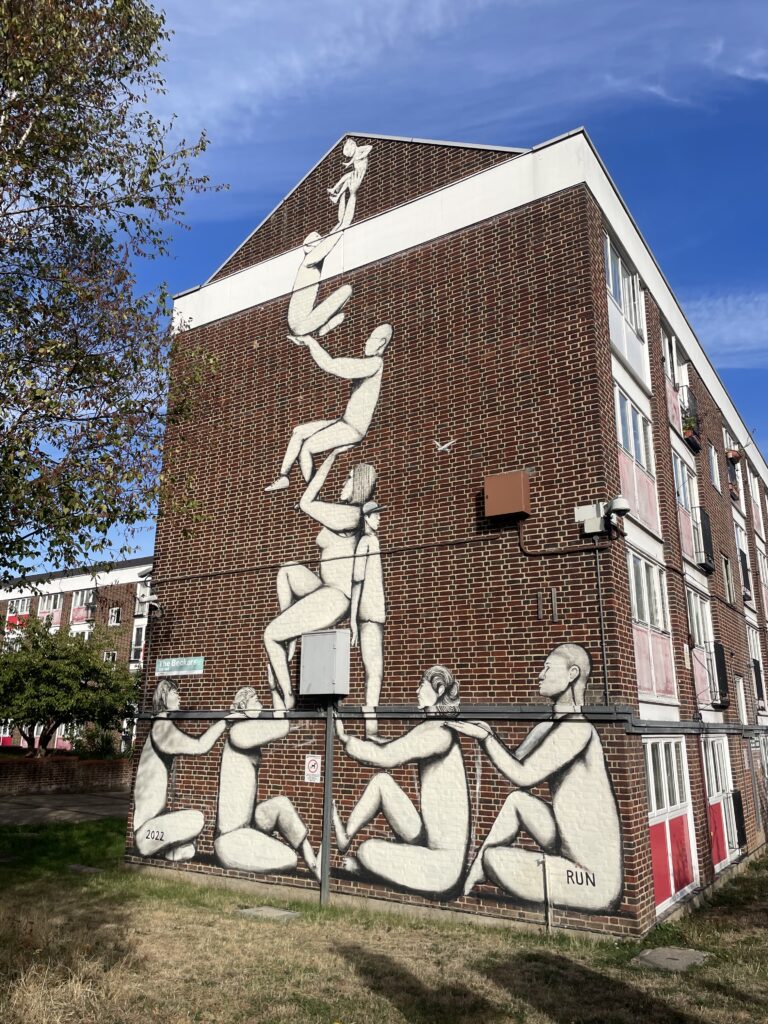
Back on The Beckers estate, RUN’s work takes on a particularly powerful local significance. Unlike paintings displayed in galleries or commissioned for prestigious exhibitions, this mural celebrating solidarity, cooperation and the strength of community belongs to the people who helped shape its message.
There is something particularly fitting about its location on a housing estate, where neighbours share not only buildings and communal spaces but also the challenges and experiences of everyday life. The figures rising towards the roofline offer a simple but powerful reminder that no one stands entirely alone and that collective strength comes from people supporting one another.
In a borough where redevelopment, rising costs and rapid social change can wipe out established communities in the matter of just a few years, that message feels especially relevant.
Leave a Reply