
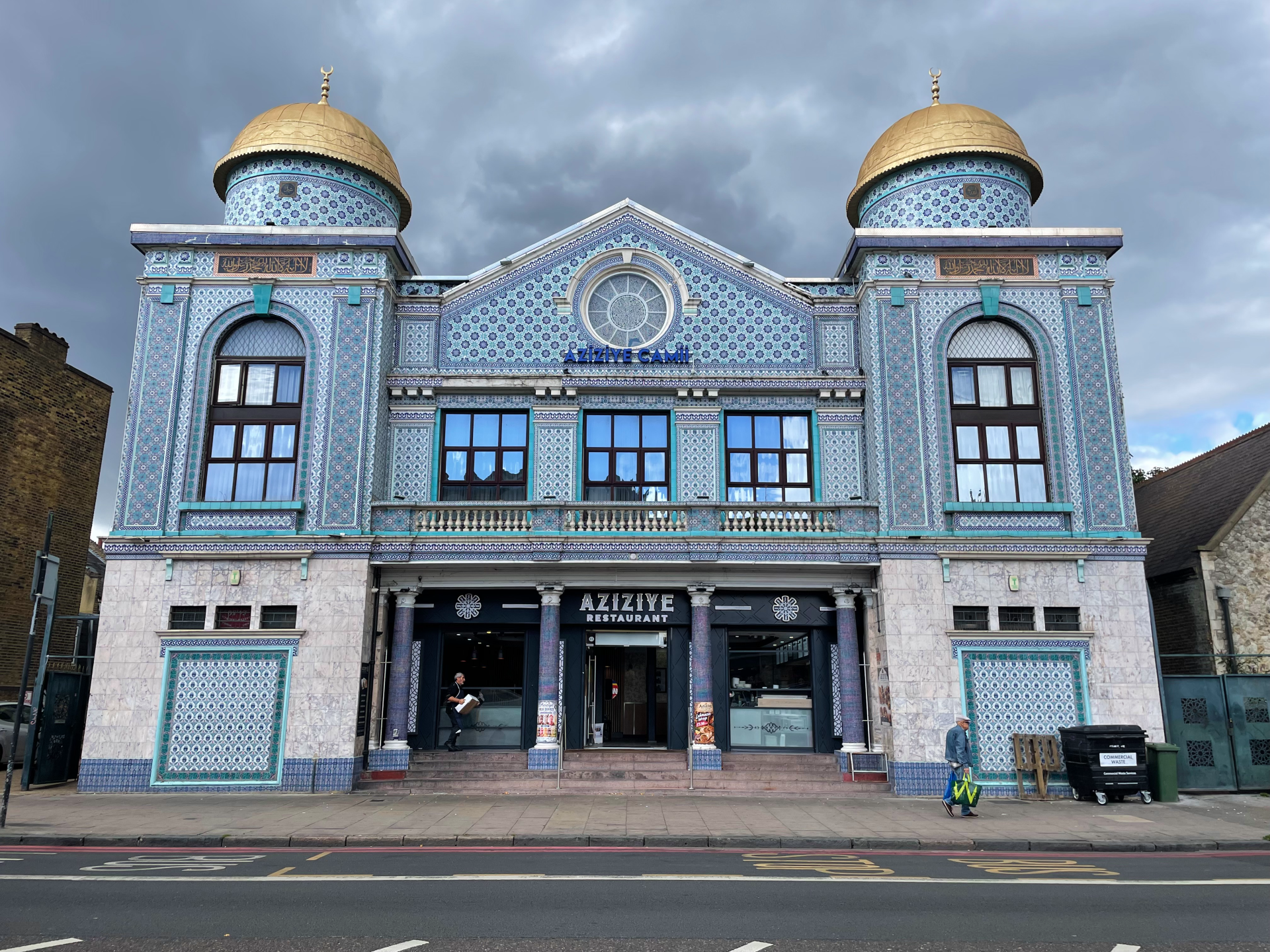
The Aziziye Mosque (London Aziziye Camii) 117-119 Stoke Newington Road, Hackney N16, is one of London’s most distinctive mosques, but some locals may remember it for the spit-roasting chickens on display outside in the mid-2000s.
It is a surreal detail in the story of a building that began life as the Apollo Picture House in 1913, later becoming the Ambassador Cinema, passing through a bingo phase before returning to cinema as the Astra and eventually being transformed into a Ottoman-style mosque with spectacular domes, minarets and richly-coloured tiles.
From Apollo Picture House to Ambassador Cinema
This building on Stoke Newington Road was completed in 1913 as the Apollo Picture House, although some sources give 1914. Research by the University of Westminster’s Moving Pictures project identifies the architect as Stanley Burdwood.
It was an unusual-looking picture house with distinctive towers topped by domes on either side of the main entrance. Its architectural style has variously been described as oriental, Moorish or Art Nouveau, giving it an exotic appearance even before it acquired its present Ottoman character.
According to Cinema Treasures’ historical theatre records, the cinema had a capacity of 1,180 seats, a figure that refers to the former cinema, not the mosque. Aziziye has since been extensively remodelled and now accommodates a much larger congregation.
In 1933 the Apollo was taken over by London & Southern Super Cinemas and modernised. It reopened as the Ambassador Cinema on the 7th of August 1933. The cinema was subsequently taken over by Watford Amusements around 1936 and acquired by Oscar Deutsch’s Odeon Theatres in 1937, although Odeon did not actually operate it directly. Instead, it was leased to an independent operator while showing Odeon-release films alongside other cinemas in the area.
Bingo, The Astra And Its Final Films
The Ambassador closed on the 7th of December 1963, bringing its first major period as a cinema to an end. The building was soon given another popular entertainment use: by 1965 it had become a Star Bingo Club. Like many former cinemas across Britain, its large auditorium made it well suited for bingo, which had become a major form of mass entertainment in the post-war decades.
The building returned to cinema use on the 8th of September 1974, reopening as the Astra Cinema. Initially it showed revival programmes and double bills, but its character changed considerably during its final years. By 1978 it was operating as a cinema club specialising in uncensored martial-arts films and soft-core sex films. The Astra eventually closed down in July 1983.
A Mosque For A Growing Turkish Community
The building’s next chapter was closely connected to the development of London’s Turkish Muslim community. The UK Turkish Islamic Association (UKTIA) had already established a mosque elsewhere before acquiring the former cinema.
According to Aziziye Mosque’s own history, the community rented premises at Simson House in 1980, converting the space into a mosque. The building on Stoke Newington Road was then purchased in May 1983 and modified for use as a mosque, officially opening for worship in 1984.
This early history is significant because Aziziye was not simply a religious conversion of an empty building: it formed part of a wider effort by Turkish Muslims in north-east London to establish institutions that combined religious life with language and community identity.
Research into London’s Turkish Muslim community records that a Turkish imam was brought from Turkey in 1983 to lead prayers and teach both children and adults. The mosque initially had a relatively broad and non-sectarian character, attracting Turkish Muslims from different backgrounds.
The move also mattered culturally. For Turkish immigrants who had felt uncomfortable or hesitant attending mosques where services were conducted primarily in English or Arabic, Aziziye provided a familiar linguistic and cultural environment. Turkish became an important part of worship, including the hutbe, or Friday sermon, reinforcing the mosque’s role as both a religious institution and a focus for Turkish community life.
Praying On The Old Cinema Floor
The transformation was initially much more makeshift than the finished mosque suggests. In 1984, shortly before Eid, the remaining cinema seats were removed and carpets were laid across the auditorium so that the congregation could use the building for prayer.
The original intention was apparently to remove the carpets after Eid and continue worship in a renovated part of the building. Instead, the congregation grew and the temporary arrangement became permanent. For almost a decade worshippers therefore prayed on the building’s original sloping cinema floor.
An Ottoman Transformation
The architectural transformation was developed by Oktay Hamit, a Turkish Cypriot architect and civil engineer. Rather than completely disguising the building’s original form, Hamit’s design worked with its existing architecture.
The old cinema already had curved towers and domed features on either side of its entrance, which could be incorporated into an Ottoman-inspired design featuring a large central dome and minarets. The exterior was subsequently transformed with richly coloured Ottoman-style ceramic tiles, giving the building the appearance of a purpose-built Turkish mosque.
The effect is particularly striking because the original cinema’s unusual architecture had already given the building an oriental appearance. The mosque’s later decoration therefore built upon an existing visual character rather than completely replacing it.
The interior transformation was considerably more extensive. The auditorium was gutted in 1994 and the remaining cinema fittings removed, the interior was redecorated with Ottoman-inspired features including Turkish tiles, chandeliers and other decorative elements.
The project was not completed immediately: accounts of the building’s transformation state that it took more than ten years for the exterior and interior work to reach completion, with many of the materials used specially commissioned and imported from Turkey.
More Than A Mosque
Aziziye developed as a community institution as well as a place of worship. Its facilities have included an education centre, halal butcher, restaurant and function space, reflecting the way Turkish mosques in London have often served as places for religious education, social activity, food and community life as well as prayer. The mosque’s own description places particular emphasis on education and the role of the building as a centre for the community.
Its importance to the Turkish community can also be seen in the wider institutional history around it. The UK Turkish Islamic Association was involved in establishing religious and educational provision, while Aziziye became a focal point for Turkish Muslims in north-east London.
At the same, time Aziziye has not remained exclusively a Turkish space. Accounts of the mosque describe a congregation that includes people from different ethnic backgrounds, while its open days and links with other local religious and community organisations have helped establish it as part of the wider Stoke Newington community.
Leave a Reply