
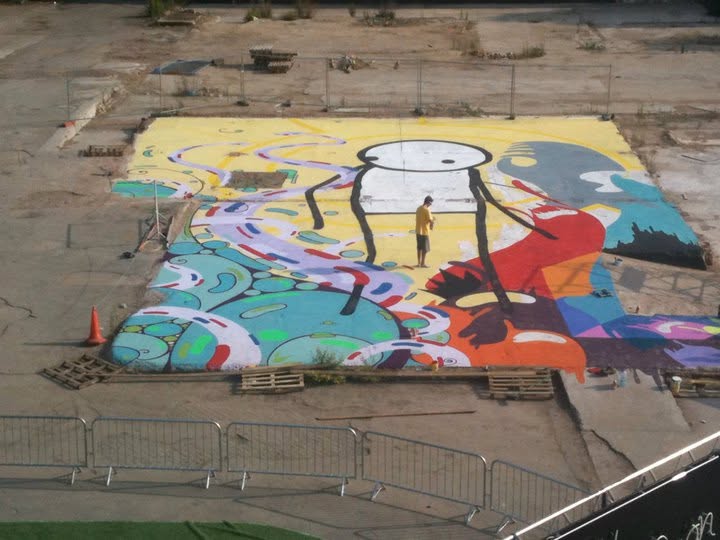
In the summer of 2011 three street artists – Stik, Milo Tchais and Prozak – transformed a derelict industrial yard in Hackney Wick into a huge temporary canvas. ‘Kids Playing in the Radioactive Field’ was the name of this striking collaboration, which captured a neighbourhood on the brink of an extraordinary change, when artists were occupying its warehouses and yards just months before the London 2012 Olympics brought unprecedented attention and redevelopment to the area.
Street Art In the Industrial Wick
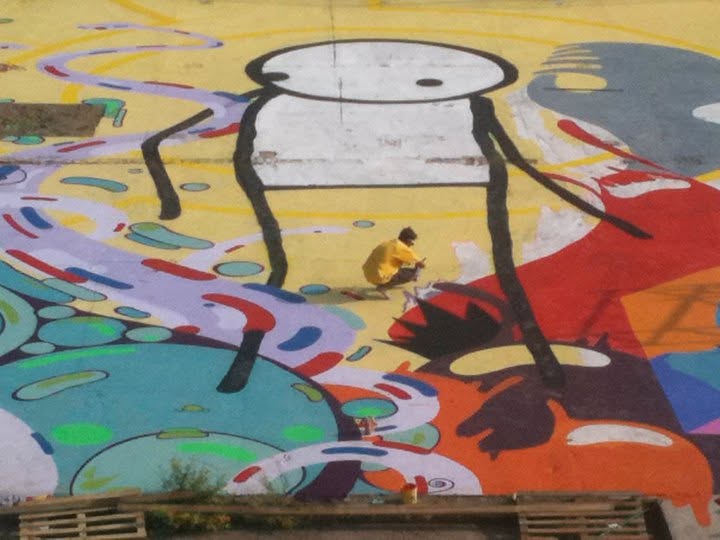
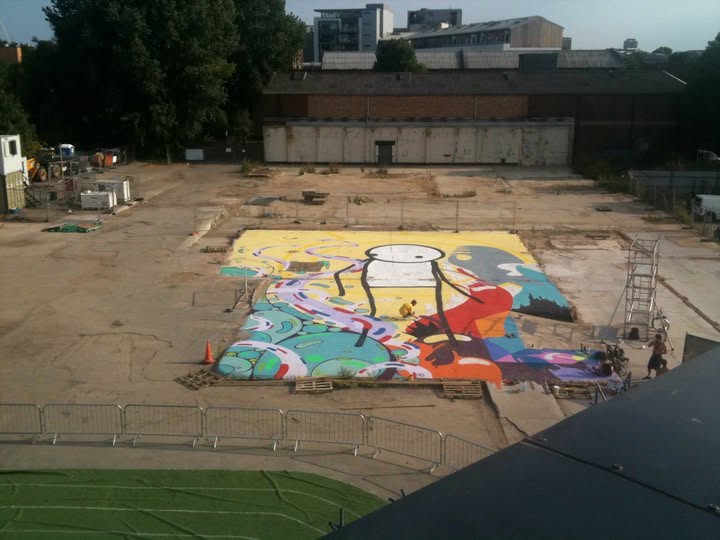
‘Kids Playing in the Radioactive Field’ spread across the concrete floor of a large site in Hackney Wick, with its enormous scale only becoming apparent from above.
The mural combined Stik’s instantly recognisable elongated human figures with the intensely coloured, organic forms associated with Brazilian artist Milo Tchais and the layered, saturated imagery of Prozak, also known as Mazu.
Milo Tchais subsequently explained that working on such a large floor piece was a particular challenge because the three artists had to make their individual styles work together as one composition.
Hackney WickED and a Neighbourhood in Transition
The mural was created as part of ‘Hackney WickED’, the area’s annual arts festival, which ran from the 29th to the 31st of July 2011. By then the festival was in its 4th year and had developed into a celebration of Hackney Wick and Fish Island, bringing together galleries, open studios, temporary exhibitions, site-specific installations, music, film and performances.
The organisers described the 2011 edition as particularly significant because it was the last festival before the transformation associated with the 2012 Olympics. The Olympic Stadium was already rising immediately across the waterways, but the surrounding landscape remained overwhelmingly industrial, with empty yards, warehouses and workshops sitting alongside an increasingly dense community of artists.
Hackney WickED deliberately used this landscape rather than hiding it: the festival’s programme extended through the streets and industrial buildings of Hackney Wick and Fish Island, turning the area’s rough edges into part of the experience.
Stik’s Hackney Connection
For Stik, Hackney Wick was not simply a convenient backdrop for a festival commission. His work had become closely associated with the wider East London street art scene, while his personal circumstances were also deeply connected with Hackney.
In an interview the following year, Stik explained that after a period of homelessness he had been housed through St Mungo’s in Hackney in 2009 and that his time there became an extraordinarily productive period for his street work. By 2011 he had moved into more stable accommodation in the borough.
The summer of 2011 was also an important moment in the development of his public profile as he also painted another huge figure in Hackney Wick during the same festival, next to the ‘Films on Fridges’ pop-up cinema on Fish Island. That separate giant Stik figure is sometimes confused with the collaborative floor mural, but the two were different works created in the same area and around the same event.
The Brazilian Connection
Milo Tchais brought another important strand to the project. Originally from São Paulo, he had been involved with graffiti and street painting there before moving to London and his work was strongly influenced by the colour, energy and visual complexity of the Brazilian street-art tradition.
Milo Tchais’ collaboration with Stik and Prozak was part of a wider Brazilian presence around the 2011 festival. This was particularly visible at Forman’s Smokehouse Gallery, where the ‘I Am Braziliality’ exhibition featured work by Brazilian artists including Milo Tchais.
In an interview that year, Tchais spoke about the Hackney Wick mural and described collaboration as an essential part of his approach, emphasising the exchange of ideas involved in making a large work collectively.
A Mural Surrounded by ‘Fridge Mountain’
The setting itself carried another layer of local history. Nearby, the ‘Films on Fridges’ pop-up cinema had been created on Fish Island using discarded refrigerator doors and other recycled components, deliberately recalling the notorious ‘Fridge Mountain’ that had once dominated the local landscape.
The huge pile of discarded refrigerators had been removed in 2005, but it remained part of local memory and had become a symbol of Hackney Wick’s industrial past. The cinema opened only days before Hackney WickED and its organisers explicitly presented the project as a response to the profound transformation taking place around Hackney Wick, Fish Island and the wider Olympic site.
A Snapshot of the Pre-Olympic Wick
Within a year, Hackney Wick would be receiving worldwide attention as one of the neighbourhoods immediately beside the Olympic Park. Much of the street art that had flourished in its warehouses and vacant industrial spaces was vulnerable to redevelopment, something artists and observers were already recognising in 2011.
Street Art London warned at the time that the future of much of the area’s street art was uncertain as the Olympics and its legacy approached. ‘Kids Playing in the Radioactive Field’ was itself temporary, but that was part of what made the work so characteristic of Hackney Wick at the time. It was created directly onto an industrial surface, experienced from surrounding rooftops and yards and photographed while still being painted.
Leave a Reply