
Palantir is on its way out of the NHS, but the controversial American technology company will remain involved in England’s health service until March 2029, despite mounting opposition from doctors, campaigners and MPs.
In Hackney, where the company’s involvement has already sparked protests and scrutiny of Homerton Hospital’s data systems, the announcement raises fresh questions about patient privacy, public trust and who should control NHS information.
A £330 Million Contract Heading for the Exit
On the 16th of November 2026, health minister James Frith confirmed in the House of Commons that the government would not continue Palantir’s existing ‘Federated Data Platform’ (FDP) contract beyond March 2029. Rather than ending the arrangement in March 2027, ministers have chosen to extend it for another two years while preparing a new competitive procurement process.
The FDP was commissioned by NHS England in November 2023, with the contract beginning in March 2024. Its purpose is to connect information held across different NHS systems, helping hospitals manage waiting lists, operating theatres, patient admissions, discharges and available beds. The platform is not intended to replace individual patients’ medical records, but to bring together information that can help NHS organisations coordinate services more effectively.
The government argues that ending the arrangement abruptly could disrupt hospitals already using the technology. Ministers want British technology companies, including smaller businesses, to compete for the replacement contract, reducing dependence on a single supplier.
Palantir, however, has not been formally excluded from bidding again, meaning its departure from the NHS is not yet guaranteed.
What Does This Mean for Hackney and Homerton Hospital?
Hackney has a particularly important connection to the controversy. In September 2026, Homerton Healthcare NHS Foundation Trust appeared before Hackney Council’s Adults, Health and Integration Scrutiny Commission to explain its digital strategy and respond to concerns about Palantir.
The Trust’s deputy chief executive, Tom Nettel, told councillors that Homerton had no active plans to use the ‘Federated Data Platform’ more widely, concentrating instead on integrating its existing systems and improving digital access for patients.
Homerton’s electronic patient record system dates back to 2004, meaning the hospital already had established digital infrastructure long before Palantir secured its national contract. There is, however, an important distinction. Earlier council correspondence confirmed that Homerton had used the FDP for specific A&E admission data, with the Trust reporting that it had received assurances about data protection.
Its September statement therefore did not mean that the hospital had never used the platform. Nor does the government’s announcement mean that Hackney residents’ medical records will suddenly be transferred to a different system or that local services will stop operating. Any eventual change will depend on the replacement technology and how NHS England manages the transition.
Hackney’s Opposition to Palantir
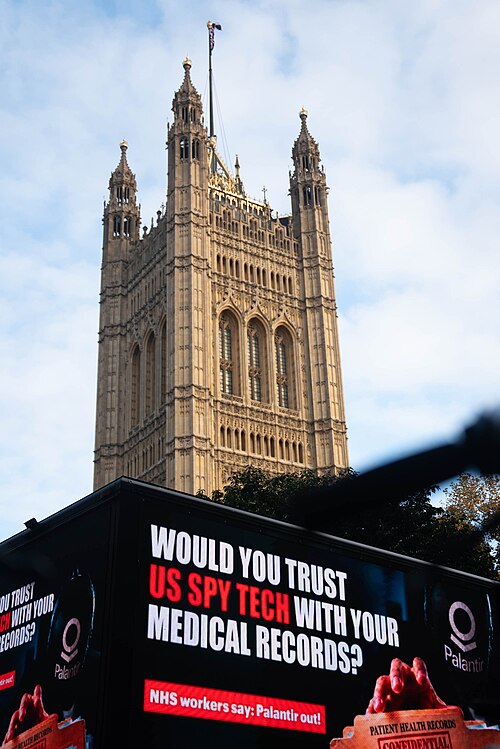
Opposition in Hackney has extended beyond national campaigning. The ‘Hackney Coalition Against Palantir’ has challenged the company’s involvement in healthcare, with local campaigners raising concerns about surveillance, immigration enforcement, military technology and the handling of confidential medical information.
At the council’s September scrutiny meeting, representatives of the coalition and ‘Hackney Patients Not Passports’ questioned Homerton’s relationship with the FDP. The meeting also involved representatives of local NHS campaign groups and the ‘Palestine Solidarity Campaign’. Their objections reflected a wider concern that a company associated with controversial government surveillance and military operations should not be entrusted with technology used by a publicly funded health service.
Hackney Council has itself adopted a clear political position. Its stated commitment is to refuse council data-sharing and partnership arrangements with companies such as Palantir where the technology is connected to military intelligence, and to press local NHS trusts to take the same approach. However, national NHS procurement decisions remain outside the council’s direct control.
Patient Data, Privacy and the Questions Nobody Can Ignore
One of the most significant revelations came in 2026, when it emerged that some Palantir employees and other contractors had been permitted limited access to identifiable patient information within part of the FDP.
NHS England subsequently acknowledged that its earlier explanations of who could access this information had been inaccurate, prompting questions from the National Data Guardian, the independent official responsible for safeguarding confidential health information.
This does not establish that Palantir sold NHS patient records, used them for military purposes or accessed them without authorisation. NHS England maintains that the platform operates under strict contractual and data protection controls. Nevertheless, the discrepancy between its original assurances and the access arrangements it later disclosed has intensified concerns about transparency.
Patients can use the NHS National ‘Data Opt-Out’ to restrict certain uses of confidential information for research and planning, although this does not generally prevent information being used for their individual care.
In October 2026, the National Data Guardian warned that rising opt-out numbers could undermine medical research and healthcare planning. She noted that the increase coincided with publicity surrounding Palantir, without claiming that the company had directly caused it.
From Covid Contracts to a National Controversy

Palantir’s NHS involvement began before the £330 million FDP agreement. During the Covid pandemic, the company supplied data-analysis technology to help the health service monitor the emergency. Further contracts followed, including agreements worth £908,000 in June 2020, £23.5 million in December 2020 and £11.5 million in August 2022.
Its early involvement prompted questions about whether providing technology at little or no initial cost had given the company an advantage in securing future public contracts. In February 2023, the government’s chief commercial officer raised concerns about the wider risk of suppliers using such arrangements to establish a foothold in public services.
Palantir has rejected suggestions that its pandemic work was intended to secure an unfair advantage.
The company’s wider business activities have also attracted scrutiny. Co-founded by billionaire Peter Thiel, Palantir supplies technology to US immigration authorities and defence organisations, including Israeli military. These relationships have prompted objections from human rights organisations and NHS workers, while Palantir maintains that its products support governments in carrying out their responsibilities.
Does Palantir’s Technology Actually Work?
Palantir argues that its software is already improving NHS efficiency. The company has attributed tens of thousands of additional operations and shorter hospital discharge delays to its technology, while NHS England has reported improvements in coordinating care and managing hospital capacity
However, the evidence has become increasingly contested. In November 2026 NHS England removed a website claim that 137 trusts were benefiting from the FDP after reporting revealed that 29 of those organisations were using the technology rarely or not at all.
The distinction between installing a system, actively using it and demonstrating measurable improvements has become central to the debate
There is also a statistical problem. NHS England acknowledged in June 2026 that improvements observed in hospitals could not automatically be attributed to the FDP because other contributing factors had not been controlled for. This does not prove the platform is ineffective, but it means claims about its benefits require more rigorous evaluation.
A Victory for Campaigners, but the Battle Is Not Over
Amnesty International welcomed the government’s announcement as a victory for healthcare workers, patients and campaigners, while the British Medical Association expressed frustration that the contract would continue for another two years. MPs from different parties have also questioned why ministers did not exercise the earlier break clause.
The immediate significance for Hackney and its residents is less about changes to hospital appointments or treatment and more about the future direction of local healthcare technology. Homerton’s decision to prioritise its existing digital systems, alongside the council’s opposition to Palantir, demonstrates how national procurement policies can come into conflict with local concerns about ethics and public accountability.
Leave a Reply